



I spent most of the week sitting with a data point I couldn’t shake, and by Friday it had connected to about four other things I’d been tracking. The design job market, an accessibility deadline almost nobody’s prepared for, Figma slowly becoming a different company, and a zoning decision in Minneapolis that says more about design than most design discourse does. There’s a thread running through all of it if you squint: who gets to decide what gets built, and what happens when the answer changes faster than the people doing the building can adapt.
Here’s what’s been open in my browser:
The ratio flipped
This is the one I kept coming back to. Lenny Rachitsky published his latest State of the Product Job Market report, and the numbers confirm something a lot of us have been feeling but couldn’t put data to. Design roles have been essentially flat since early 2023, about 5,700 open globally. That number hasn’t moved. Meanwhile, PM openings surged past 7,300 and engineering is at 67,000-plus. The demand ratio between PMs and designers has flipped for the first time: in mid-2023, there were more open designer roles than PM roles. Now PMs lead at 1.27x.
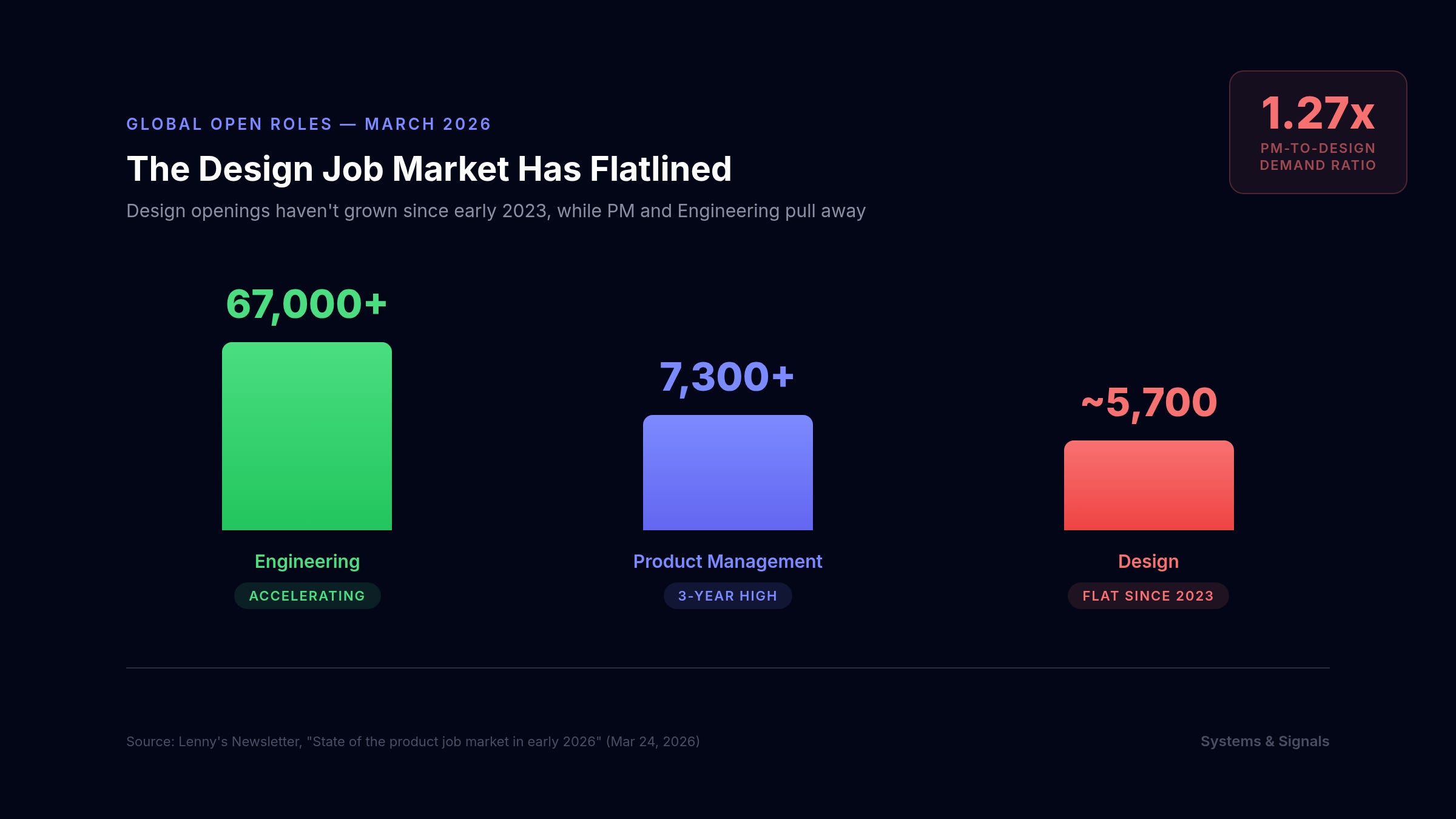
Lenny’s hypothesis for why is worth sitting with: AI-enabled engineering velocity is reducing the perceived need for traditional design process. Engineers are shipping functional UI faster than designers can mock it, and PMs are filling the concept gap with AI-assisted first drafts. The design bottleneck that justified headcount for a decade is getting routed around.
NN/g’s State of UX 2026 report landed around the same time with a complementary read. Their framing: “design deeper to differentiate.” UI is commodified. Design systems and AI tools have made competent interfaces tablestakes. The competitive advantage has moved upstream to strategy and judgment. The practitioners who thrive will be the ones treating UX as problem solving, not deliverable production.
If those two reports aren’t the same argument from different angles, I don’t know what is.
State of the Product Job Market in Early 2026 — Lenny’s Newsletter
UX Designer Job Market Reality: What Changed in 2026 — UX Playbook
Four weeks until the biggest accessibility deadline in U.S. history
April 24, 2026. That’s when every state and local government serving 50,000 or more people must comply with WCAG 2.1 Level AA for their websites and mobile apps. Not guidelines, but requirements with DOJ enforcement behind them.
The scope is wider than most people realize. It covers public websites, mobile apps, third-party portals (the ones you use to pay a water bill or file a permit), and document libraries including PDFs and Word docs that are still publicly available. Automated remediation tools aren’t enough; the DOJ explicitly says manual testing is required.
I’d bet real money that the majority of affected jurisdictions aren’t ready. And for anyone in accessibility consulting, gov-tech, or civic design, the demand spike from this deadline is going to be significant.
Figma bought its way out of being a design tool
Figma’s acquisition of Weavy (reportedly north of $200 million, their largest ever) is less about what Weavy does and more about what Figma wants to become. Weavy brings a node-based AI canvas where you can feed prompts to multiple models simultaneously (Sora, Flux, Ideogram, Seedance), compare outputs, and edit results with professional image and video tools. As Figma Weave, it adds media generation and VFX capability to the Figma platform.
Pair that with Config 2025’s announcements (Sites, Draw, Buzz, Make) and Figma has gone from four products to eight in under a year. They’re not competing with Sketch anymore. They’re competing with Adobe, Canva, and Framer at the same time. Whether that ambition survives contact with Figma’s current stock price is another question.
Colorado’s AI law arrives June 30, and it puts designers in the frame
After a year of delays and political back-and-forth, Colorado’s AI Act takes effect June 30. It’s the first enforceable U.S. state law that goes after algorithmic discrimination directly, not just data privacy. If you deploy a high-risk AI system, you now need to document the risks, disclose how it works, and run impact assessments. “Reasonable care” is the legal standard, which means someone will eventually have to define what that looks like in practice.
If you’re designing anything that uses AI to make decisions about people, whether that’s a hiring tool or a lending interface, this is your homework. The EU AI Act’s high-risk rules follow in August. The compliance era for AI isn’t coming; it’s here.
“Phygital” retail grew up
EuroShop 2026 happened last month, and for the first time the “phygital” retail stuff felt like infrastructure instead of a trade show gimmick. AI-powered smart mirrors recommending products. Virtual “endless aisles” letting customers configure the full catalog from the store floor. Adaptive lighting systems that shift atmosphere based on time of day and customer traffic. Modular visual merchandising that lets you swap a campaign in hours, not weeks.
The sustainability angle was just as notable. Recycled waste panels, certified wood, reusable modular structures. It’s not optional anymore — it’s how the stores are being built. For anyone in retail design, the job description quietly shifted from “store design” to “system design” and EuroShop made that visible.
One more tab…
Minneapolis eliminated single-family zoning citywide a few years ago, and the data is now in: land values in upzoning corridors outperformed the citywide average by 28 to 44 percent over three-year windows. The “post-zoning urbanism” movement is gaining traction in other cities adopting similar mixed-use overlays. If you think zoning isn’t design, you haven’t looked closely enough at what it determines about how people actually experience their city.
Coming this week: The demand gap data from Lenny’s report landed the same week Cameron Moll posted something I haven’t been able to stop thinking about. His argument: while design has been debating craft and taste, everyone else started shipping. The numbers back him up. Monday’s issue gets into what the ratio flip actually means, how orgs are restructuring around AI velocity, and whether the version of design most of us trained for still has a market. It’s the sharpest piece I’ve written in a while and I’m not sure everyone’s going to like it.
See you tomorrow — Justin