



It’s Sunday afternoon, football on, and I’m about to have lunch delivered by a robot. Somewhere in a nearby parking lot, a little boxy vehicle with two glowing ring lights — “eyes,” I guess — is navigating crosswalks to bring me a chicken wrap I could’ve made in ten minutes. It’s cute, because it was designed to be. A friendly, anime-eyed courier rolling toward me on four wheels, making it easy to forget that it took a job from an actual human being.
For all our talk about “human-centered design,” the truth is we’ve centered the human who pays and not the human who labors.
I’m saving five dollars — not because of a promo code or a loyalty perk, but because there’s no one left to tip in this absurd chain of convenience.
This is the modern miracle: a $10 lunch for $20, mechanically delivered and morally dissonant.
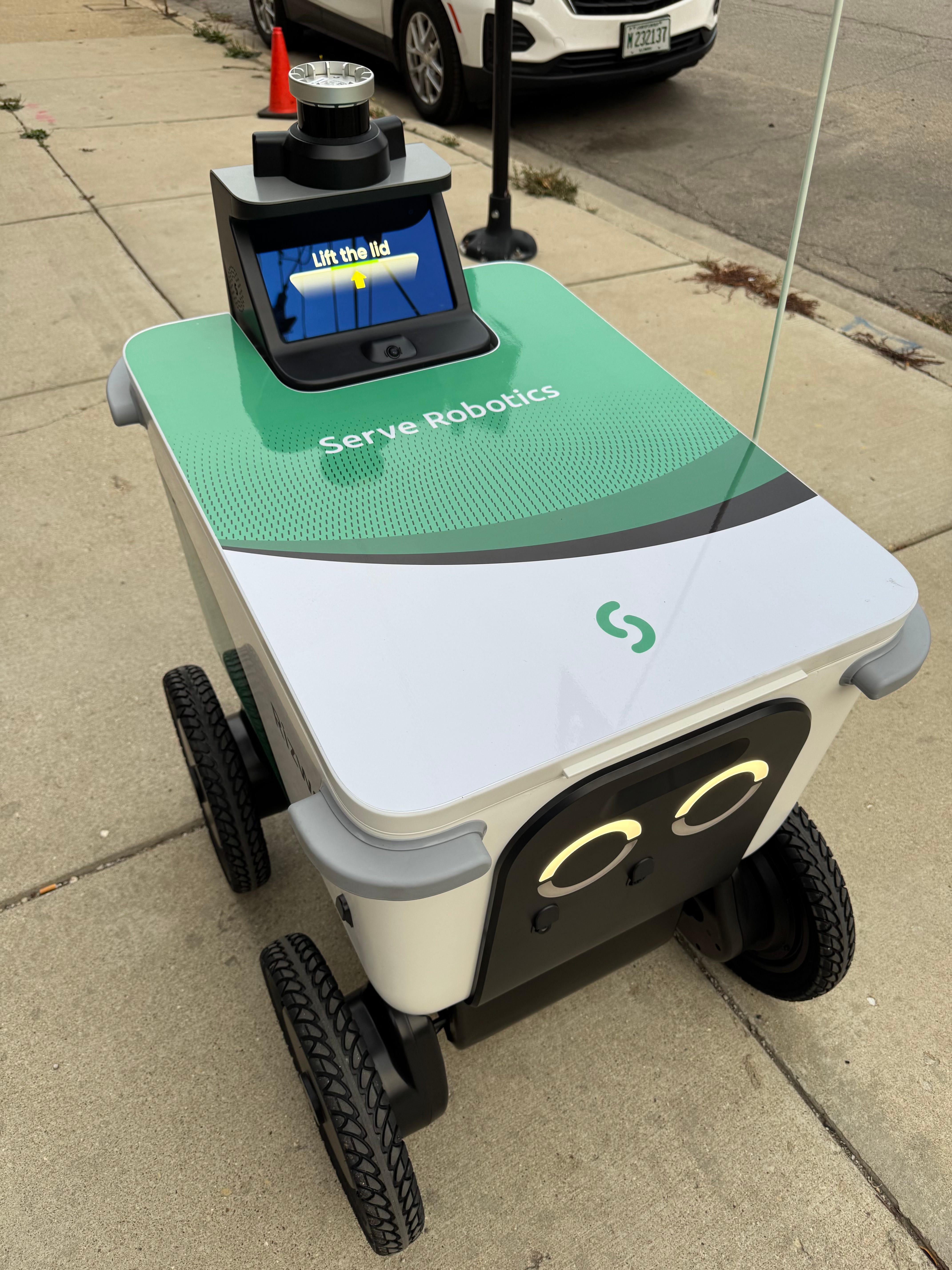
I tell myself it’s fine. It’s been a long week, I don’t feel like cooking, and besides, this is the future, right? But as the little robot rolls up to my door, I can’t shake the feeling that what we’ve really built isn’t the future at all. It’s an intricate system designed to protect us from ever feeling inconvenience.
The problem is that comfort scales. What starts as a small luxury — skipping the line, splitting a payment, tapping instead of typing — becomes a default expectation. We build technologies to erase friction, and in doing so, we erase the very effort that used to connect us to consequence. The economy adjusts, labor shifts, and before long, we’re paying real people less so we can feel slightly less bothered.
We used to design for delight. Now we design for ease. And somewhere along the way, ease became the enemy of meaning.
The Comfort Economy
The economy of comfort is built on asymmetry. Those with means buy time; those without sell it.
Comfort has become the organizing principle of modern life. We’ve built an economy where the highest good is the absence of friction — the shortest line, the fastest route, the fewest taps. The underlying assumption is that ease equals progress, and every moment saved is value created.
Amazon taught us this lesson better than anyone. Next-day delivery started as a marvel of logistics, an engineering triumph. Today, it’s a moral gray zone wrapped in a cardboard box. Every package represents an invisible supply chain of human exhaustion and environmental cost — sprawling fulfillment centers, overnight shifts, and carbon-choked “last mile” delivery routes that now account for nearly a third of all urban traffic emissions. We don’t see the trucks idling at 3 a.m. or the drivers racing algorithms to hit quotas. We see a smiling arrow and a tracking number that reassures us our needs are being met — instantly.
The same logic governs our finances. Buy Now, Pay Later promised flexibility and democratized access, but it quietly re-normalized consumer debt as a lifestyle. It converts our future discomfort into present convenience, monetizing our inability to wait. The system works because it feels painless — until it doesn’t.
Every comfort is borrowed from somewhere: a driver’s time, a warehouse worker’s body, a planet’s capacity to absorb another round of expedited consumption. The costs are simply hidden far enough away that we can mistake them for efficiency.
We call it innovation, but it’s really anesthesia — a collective numbing of what it takes to make life feel effortless.
Discomfort as a Feature, Not a Bug
We’ve spent two decades engineering away discomfort — the wait, the walk, the planning, the patience — all the minor frictions that once tethered effort to outcome. But the absence of friction doesn’t make life better; it just redistributes it. Someone, somewhere, is still carrying the weight you put down.
The economy of comfort is built on asymmetry. Those with means buy time; those without sell it. Every tap-to-order convenience depends on an invisible workforce navigating low wages, unstable hours, and algorithmic oversight to make the miracle happen. We’ve created a hierarchy of effort: the affluent get frictionless living, and everyone else becomes the friction.
What used to be shared labor — cooking, cleaning, driving, waiting — has been offloaded to the gig layer of the economy. The apps that promise empowerment have instead produced a subclass of flexible workers optimized for other people’s (read: my) laziness. The more convenient the service, the less stability behind it. Comfort compounds for those who can afford it and corrodes opportunity for those who can’t.
Even our attempts at “ethical consumption” are steeped in irony. You can offset your carbon at checkout while still expecting free next-day delivery. You can tip the delivery driver generously, but it won’t change that their pay structure assumes you will. We’ve built a system where empathy is optional, but immediacy is not.
For all our talk about “human-centered design,” the truth is we’ve centered the human who pays — not the human who labors. Discomfort used to remind us of connection, of interdependence. Now, it’s a signal that something went wrong in the customer journey.
What Comfort Costs Design
Every tap that saves me a step costs someone else a stride.
Let’s imagine the other side of my robot-delivered lunch.
Somewhere across town, a gig worker named Luis starts his day at 6:00 a.m. The app tells him where to go, what to carry, and how fast to get there. He’ll earn less than minimum wage after expenses — gas, maintenance, the service fee that somehow doesn’t serve him. He’s working this weekend because his daughter’s antibiotics cost more than the copay he can afford. He doesn’t have benefits or predictable hours, but he does have ratings. And he knows that one delayed delivery, one wrong turn, one moment of human error could mean fewer jobs tomorrow.
I never see Luis. I just see a glowing progress bar that tells me lunch is on its way.
This is how the system keeps itself tidy: every bit of effort we remove from the customer’s experience has to land somewhere else. We don’t erase friction; we outsource it. And in that transaction, design becomes a weapon of abstraction — the art of making hard things invisible.
When we celebrate frictionless design, we rarely ask whose friction we’re erasing. We optimize flows, streamline journeys, automate empathy. We hide human strain behind loading animations and clever copy that says, Your order is being prepared.
Our tools have made it easy to treat ethics as a configuration option — something to toggle on after MVP, or after funding, or after scale. But the truth is: design doesn’t just shape experiences; it shapes economies. Every tap that saves me a step costs someone else a stride.
At some point, we need to decide whether the role of design is to remove effort or to redistribute it more justly.
Choosing Discomfort
The robot leaves, and for a moment I just stand there, watching its little ring-light eyes blink before it turns and rolls back down the street. Somewhere out there, it’s already on its way to the next stop, performing its task with perfect composure — polite, tireless, and empty. It doesn’t need to rest, or eat, or be tipped. It just moves.
I unwrap the sandwich and feel the hum of absurdity in my apartment. An entire ecosystem just mobilized so I wouldn’t have to. The software, the warehouses, the investors, the grid — all calibrated so I could sit in comfort, alone, watching a game while a machine did the labor once done by a person. It’s efficiency at a planetary scale, and yet it feels strangely hollow.
I’m not exempt from this system; I’m embedded in it. I’ve spent a career building technology meant to make life easier — smoother checkouts, faster pages, fewer steps. All good intentions. But good intentions don’t balance the ledger when the result is a world designed to shield us from even mild inconvenience, all while externalizing its discomfort onto those least equipped to bear it.
The truth is, progress has always required discomfort. Every meaningful experience — learning, creating, connecting, growing — involves friction. When we erase that, we erase part of what makes us human.
Maybe the antidote isn’t to reject convenience outright but to reintroduce choice — to treat discomfort as a signal, not a defect. To occasionally walk instead of scroll. To wait instead of click. To remember that friction can be a form of participation, a reminder that effort still matters.
Next time, maybe I’ll walk down the block and order my food from a real person. Maybe I’ll hand over a few extra dollars for the privilege of looking someone in the eye and saying thank you. A small act, but in a world that treats effort as failure, it might just be a start.