


The Design Your Next Move Series:
Part 1: Your Design Career Won’t Be Killed by AI; It’ll Be Killed by Inertia
Part 3: From Craftsperson to Conductor
Part 9: Your Career OS Is a Living System
“Your value isn’t in the thing you make — it’s in the direction you help the organization move.”
The craft that built us
When I started in design, I was obsessed with craft — beautiful typefaces, pixel-perfect spacing, learning every tool inside out. I’d spend hours on a single interface, tweaking contrast ratios, testing different interaction patterns, building components that could scale. That obsession was essential, because it’s how you learn the discipline, how you build confidence, and how you develop the judgment that lets you know when something is actually good instead of just finished.
Twenty years in, I still care about craft, but if I spent most of my time optimizing pixels and perfecting layouts, I’d be irrelevant in about eighteen months.
The automation problem
Here’s why that matters: the craftsperson skills that got most of us into design are being automated. I don’t mean designers are obsolete — I mean the work is changing. AI can turn a wireframe into a polished mockup in seconds, component libraries have eliminated the need to design every screen from scratch, and template systems churn out reasonable layouts faster than any human designer ever could. The tasks that used to require deep design thinking — the ones that felt like magic when you were early in your career — are increasingly being handled by tools or standardized processes.
If your value is “I make things look good,” that value is eroding, not because you’re not good at it, but because the market no longer needs you to be the person who makes things look good when it can hire a tool for that.
What a conductor actually does
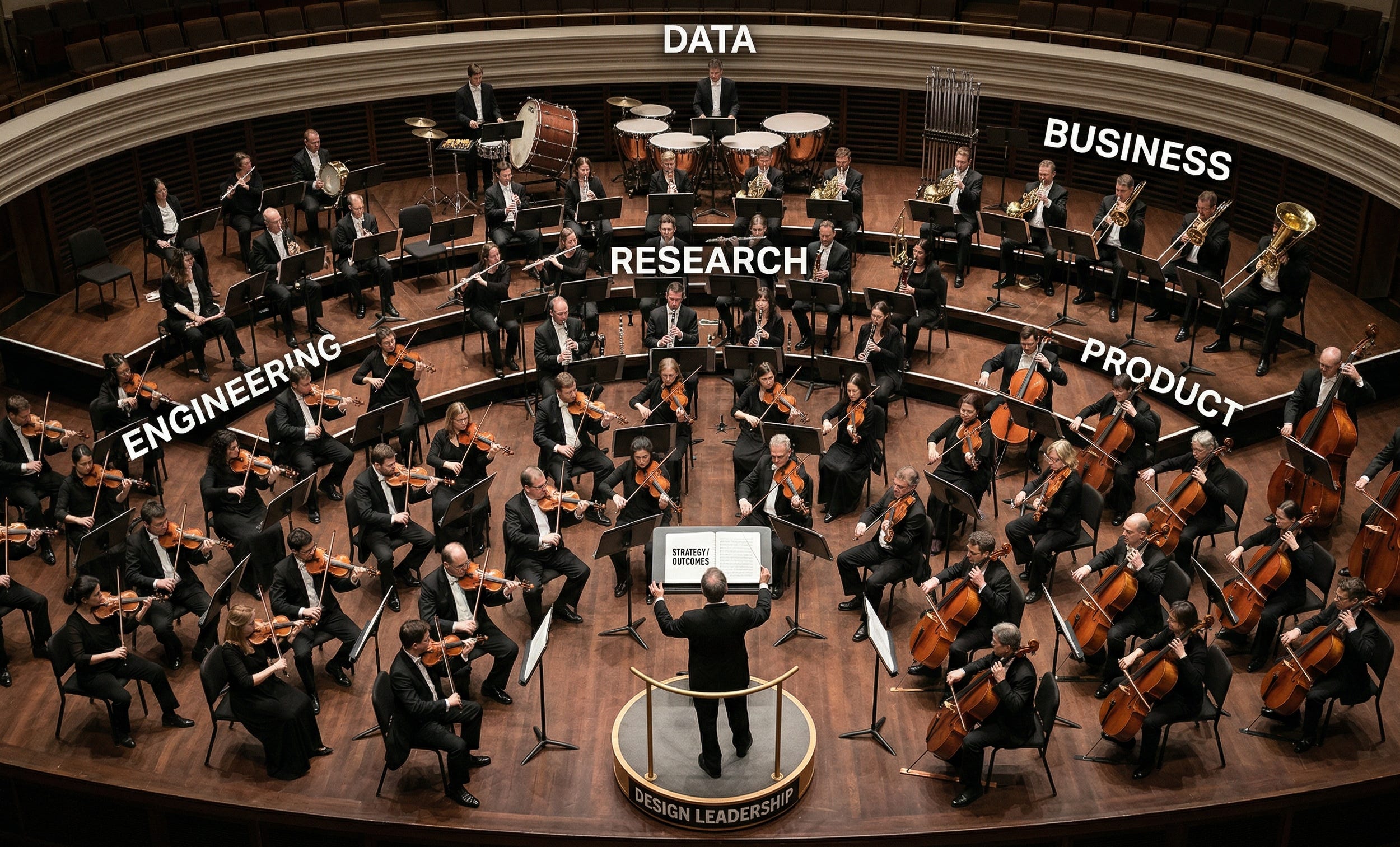
So the designers who are going to stay valuable, stay interesting, stay employed are the ones who’ve made a transition — not away from design, but beyond it, from craftsperson to conductor.
Think of an orchestra conductor. The conductor doesn’t play every instrument, and in fact the best conductors aren’t necessarily the best instrumentalists. What they do is set the tempo, cue the entries, shape the dynamics, and keep the whole group aligned on what they’re trying to create together. They understand each instrument’s role in relation to everything else, and they know which parts need to be louder, which need to recede, and where the real emotional force lives. That’s the shift that matters now.
In craftsperson mode, you’re executing design specs, refining interfaces, and optimizing visual polish — your value is in the quality of the work you produce. In conductor mode, you’re shaping outcomes, enabling others, translating between worlds, and ensuring coherence across a system — your value is in the decisions that get made, the alignment you create, and the problems you help the organization see more clearly.
When you’re operating as a conductor, you’re spending as much time in alignment conversations as you are in Figma, and your peers come to you for clarity on the bigger picture rather than for design feedback. You’re asking “What’s the real problem we’re trying to solve?” before anyone agrees on a solution, and you’re influencing the sequence and scope of work rather than just executing what’s handed to you. You’re the person removing roadblocks so other people can do their best work.
Why this can’t be automated
And here’s what makes this transition critical right now: conductor skills are nearly impossible to automate. You can generate a layout, but you can’t generate strategic clarity. You can template an interface, but you can’t template the conversation that helps a VP of Product understand why a user research finding actually matters to their roadmap. You can build a component library, but you can’t automate the invisible work of keeping a demoralized team convinced that their work matters.
When you shift to conductor mode, you become harder to replace — you’re influencing decisions rather than just executing deliverables, you’re seen as a strategic partner rather than a cost center that happens to use Figma, and you’re future-proofing yourself against automation because your value isn’t in the thing you make but in the direction you help the organization move.
I often joke that PowerPoint is my main design tool, but it’s not so much a joke as an actuality. I spend way more time in slides than I spend in design tools these days, not because I’ve abandoned design, but because the work that matters most isn’t the interface anymore — it’s the story, the alignment, and the decision-making framework that helps the right people understand why we’re making the choices we’re making.
How to know if you’re already there
How do you know if you’re already operating in conductor mode? You spend as much time in alignment conversations as in your actual design tool, you often ask “What’s the real problem we’re trying to solve?” before anyone has decided on a solution, and peers come to you for clarity on the bigger picture rather than just design feedback. You influence the sequence and scope of work instead of just executing what’s handed to you, you spend energy creating air cover so your team can do its best work, and you think in outcomes instead of outputs. You say no sometimes, because you understand that capacity is a design constraint, not a moral failing.
The good news is that this transition isn’t about abandoning what you’re good at — it’s about adding a new lens on top of it. You still make things look good, you still care about interfaces and user experience, but you’ve added a layer that asks “What does this interface need to accomplish for the business? How does it fit in the larger system? What conversation does it enable? What’s the one thing that has to be true for this to matter?”
Thanks for reading Systems & Signals! Subscribe for free to receive new posts and support my work.
Give yourself permission
The hard part isn’t learning to think this way, because most designers who’ve been in the field long enough already have some of these instincts. The hard part is giving yourself permission to do it. There’s still a lot of cultural baggage in design that says “real design is visual design” or “real designers are makers” or that the work that matters most is the output you can put in your portfolio, and none of that is true anymore, if it ever was.
The designers I admire most — the ones who have the most influence, the most agency, the most job security in an uncertain market — are the ones who’ve figured out how to be both craftspeople and conductors. They still care about the interface, but they care more about why that interface is being built, what conversation it enables, how it fits into the larger system, and what it’s supposed to accomplish. That’s not a diminishment of craft — it’s the maturation of it.
A different kind of rigor
The work you do as a conductor is just as rigorous as the work you do as a craftsperson, it’s just rigorous about different things. Instead of pixel-perfect layouts you’re optimizing for clarity and alignment, instead of visual perfection you’re optimizing for outcomes, and instead of individual interfaces you’re thinking about the system they’re all part of.
And here’s the thing that makes this shift feel urgent: the market is moving faster than a lot of design teams realize. Companies are restructuring, tools are automating, and AI is accelerating the commoditization of the visual work. The craftspeople who built their entire identity around excellence in execution are going to have a much harder time in the next five years than the people who’ve already started thinking like conductors.
Activity: Where are you already a conductor?
Don’t start from zero — you’re probably already doing some of this work, even if you don’t think of it that way.
Think back to the last month. When have you brought people together to solve a problem, even informally? When have you advocated for a different direction, even when it was risky? When have you asked “Why are we doing this?” and actually changed the conversation? When have you protected your team from chaos, or helped someone see something they weren’t seeing before
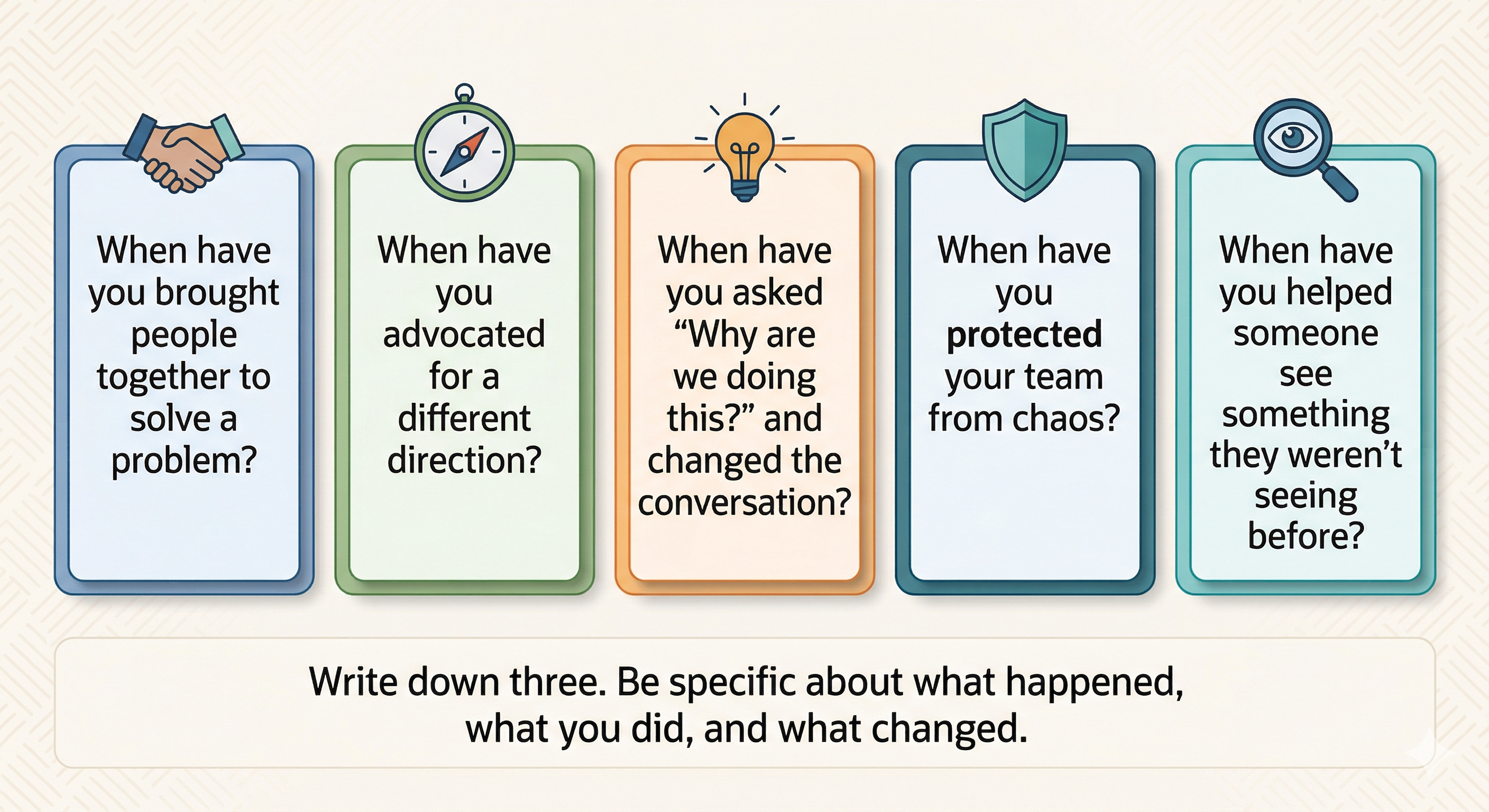
Write down three examples, and be specific about what happened, what you did, and what changed as a result.
That’s conductor work, and you’ve already started doing it. The question is whether you’re going to lean into it, own it, and build your identity around it — or whether you’re going to keep apologizing for the time you spend away from your design tool and acting like it’s not real work. Because it’s the most real work you do.