



The Design Your Next Move Series:
Part 1: Your Design Career Won’t Be Killed by AI; It’ll Be Killed by Inertia
Part 5: Make the Invisible Visible
Part 9: Your Career OS Is a Living System
The higher up you go in an organization, the more your actual value shifts toward work that nobody measures — and if you can’t articulate that work, you will lose out on promotions, roles, and compensation to people who can. Not because they’re better than you, but because they’ve figured out how to make the invisible visible, and you haven’t.
This is the central tension of career growth for designers and design leaders: the work that matters most is often the work that’s hardest to point to. By the time you’re competing for a senior role or making the case for a raise, a portfolio of polished screens won’t capture the thing that actually made you indispensable. What will capture it is your ability to name, frame, and communicate the work that shaped how things got made — even when that work never had a deliverable attached to it.
I published a piece a while back called “The Invisible Work of Design Leadership,” and it clearly struck a chord, not because it was saying anything new but because a lot of people read it and realized they’d been doing invisible work for years without ever naming it, documenting it, or giving themselves credit for it.
So what is invisible work, exactly? It’s everything your manager doesn’t see in a status update, everything that won’t show up in your portfolio, everything that doesn’t have a commit message or a line item on a roadmap. It’s the kind of work that shapes outcomes so fundamentally that people forget it was ever work at all — they just think that’s how things are supposed to be.
Some examples:
Stakeholder navigation. You’re in a meeting where the CMO is pushing for a feature that directly contradicts what research told you six months ago. You could shut it down. Instead, you ask questions. You reframe the underlying need. You find a way to get to the same place the CMO wants to go, but through a path that doesn’t break the system you’ve designed. Later, everyone thinks it was a great idea. Nobody remembers that you basically negotiated two different worldviews into alignment.
Team protection. You’re getting constant escalations from leadership about firefighting instead of building the roadmap. Your team is demoralized because they can’t finish anything. So you start acting as the filter. You take the escalations. You absorb some of them. You reframe others. You push back when you need to. You’re creating what people call “air cover” — a buffer so your team can actually do their best work instead of living in constant crisis mode.
Problem reframing. Someone brings you a solution in disguise. They say “We need a design for a new flow.” You could just design the flow. Instead, you ask “What problem are we trying to solve?” Turns out they’re solving the wrong problem. You help them see it. You propose testing a different hypothesis first. The redesign would have cost weeks and confused users. The reframed approach solves it in two days.
Strategic influence. You notice that three different product initiatives are all asking for overlapping design work because nobody’s coordinating. So you set up a meeting. You create a simple roadmap that shows how they could sequence differently. You propose a shared component strategy that would speed everyone up. Suddenly the three initiatives that were competing for the same limited design capacity can move in parallel. You didn’t do the work. But the work got better because you influenced how it was sequenced.
Here’s the thing: if you don’t document and communicate this work, nobody else will.
Your manager might notice it eventually. Your peers might appreciate it in the moment. But unless you actually name it, frame it, and show it, a lot of people will just assume it was easy or inevitable or that somebody else did it. This isn’t self-promotion — it’s clarity. It’s the difference between being the person who “makes things look good” and being the person who “shapes how good things get made.”
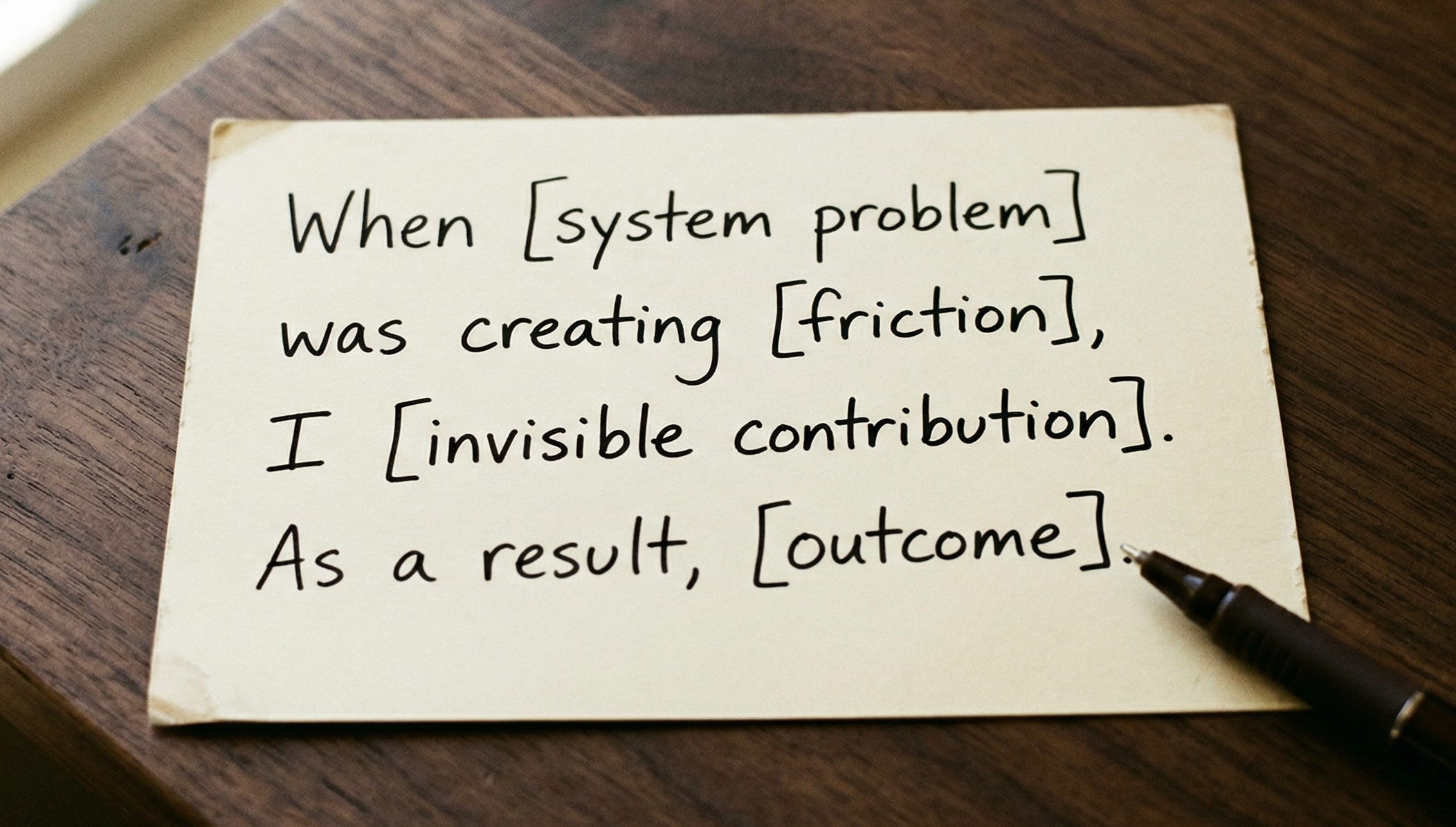
I developed a simple framework for capturing this work, and I’ve shared it with a lot of people who’ve found it useful. It goes like this:
When [system problem] was creating [friction], I [invisible contribution]. As a result, [outcome].
It’s simple but it forces you to be specific:
System problem: What was actually broken or at risk? Not “the team was scattered” but “we had three competing design initiatives with no shared roadmap, and people were asking me daily to prioritize between them.”
Friction: What was that creating? “People were working in silos. Decisions were inconsistent. Engineering was waiting for clarity.”
Your invisible contribution: What did you actually do? “I created a sequencing roadmap and proposed a shared component library.”
Outcome: What changed? “All three initiatives could move in parallel. We shipped 40% faster than if they’d been sequential.”
That’s it. That’s the template. And it works because it forces you to think in terms of systems and outcomes instead of just describing tasks.
When [our stakeholders were locked in disagreement about user research findings], I [framed the research in business terms and showed how both perspectives could be partially right]. As a result, [we moved from debate to a shared hypothesis we could test].
When [my team was in constant triage mode], I [started acting as a filter for escalations and pushing back on scope]. As a result, [we protected enough capacity to ship the roadmap instead of just firefighting].
When [design decisions were being made without understanding how they’d affect the broader system], I [started asking questions in design reviews that connected individual decisions to larger strategy]. As a result, [we caught inconsistencies before they became costly rework].
This framework also solves the problem I opened with — proving your value when the main things you do aren’t measurable or visible. In a world where management increasingly wants to see clear ROI and impact, invisible work can make you feel like you’re constantly defending your existence. But the moment you start naming it, framing it, and showing how it connects to outcomes, it’s not invisible anymore — and the case for your next role starts writing itself.
The tricky part is actually doing this without sounding like you’re taking credit for other people’s work or being obnoxious about it. The key is context and honesty. You’re not saying “I made this happen.” You’re saying “I contributed this to a system where a lot of people were doing important work.”
I usually document this stuff in a few places:
In my own notes. I keep a running list of things that happened that quarter that wouldn’t show up on anyone’s metrics but that mattered. When it comes time to have a conversation about growth or compensation or a new role, I have actual examples instead of a vague sense that I’ve been valuable.
In conversations with my manager. Not as a demand or a negotiation, but just as context. “I want to flag something that doesn’t show up in the standard deliverables. This quarter I spent a lot of time helping three initiatives get aligned on sequencing. It freed up about 40% of design capacity that would have been lost to context switching.” My manager’s response is usually “Oh yeah, I noticed that happened.” The benefit is it’s no longer invisible to them.
In presentations or updates to leadership. When I’m showing work to stakeholders, I sometimes include a slide about how the work got unblocked. “We could ship this fast because we solved this coordination problem three months ago.” It connects the dots and shows that the work that made the delivery possible is worth understanding.
In my own reflection. I try to do this monthly: What invisible work happened this month? What problems did I help solve that nobody’s going to measure? What air cover did I create? What conversations did I enable? If I can’t articulate it, then I’m probably not being intentional about it.
The reason I’m emphasizing this now is that invisible work is the realm where conductors live. It’s where your real strategic value lives. It’s the work that AI won’t automate and that your next company will actually care about — even if your current company takes it for granted.
When you make invisible work visible, two things happen: First, you actually start getting credit for what you’re doing. Second, you start being more intentional about doing it. Because the work that’s easy to forget is the work that’s easy to deprioritize or to let slip away.
Activity: Document Three Examples
Pick the last three months. Identify three pieces of invisible work you did. Not three projects. Three examples of work that shaped how projects happened or what got made or how decisions got made.
Use the template:
When [system problem] was creating [friction], I [invisible contribution]. As a result, [outcome].
Write each one. Be specific. Don’t oversell it. Just be clear.
Then do one more thing: share at least one of them with your manager or a peer you trust. Not as a negotiation. Not as a demand for recognition. Just as context. “I want you to know about something that happened this quarter that might not be obvious.”
The first time you do it, it’ll feel weird. You’ll worry about sounding like you’re bragging. You won’t. You’ll just sound like someone who understands their own work.
And that’s the person who gets to design their career instead of just watching it happen.