



The Design Your Next Move Series:
Part 1: Your Design Career Won’t Be Killed by AI; It’ll Be Killed by Inertia
Part 9: Your Career OS Is a Living System
Lenny Rachitsky published his latest job market analysis last week. If you’re a designer, the numbers should make you uncomfortable.
There are roughly 5,700 open design roles globally. That number has been flat since early 2023. Not declining, but not growing either. Just flat. Meanwhile, PM openings have climbed to 7,300 and engineering is north of 67,000. In mid-2023, there were actually more open designer roles than PM roles. That ratio has flipped. PM demand is now 1.27x designer demand and pulling away.
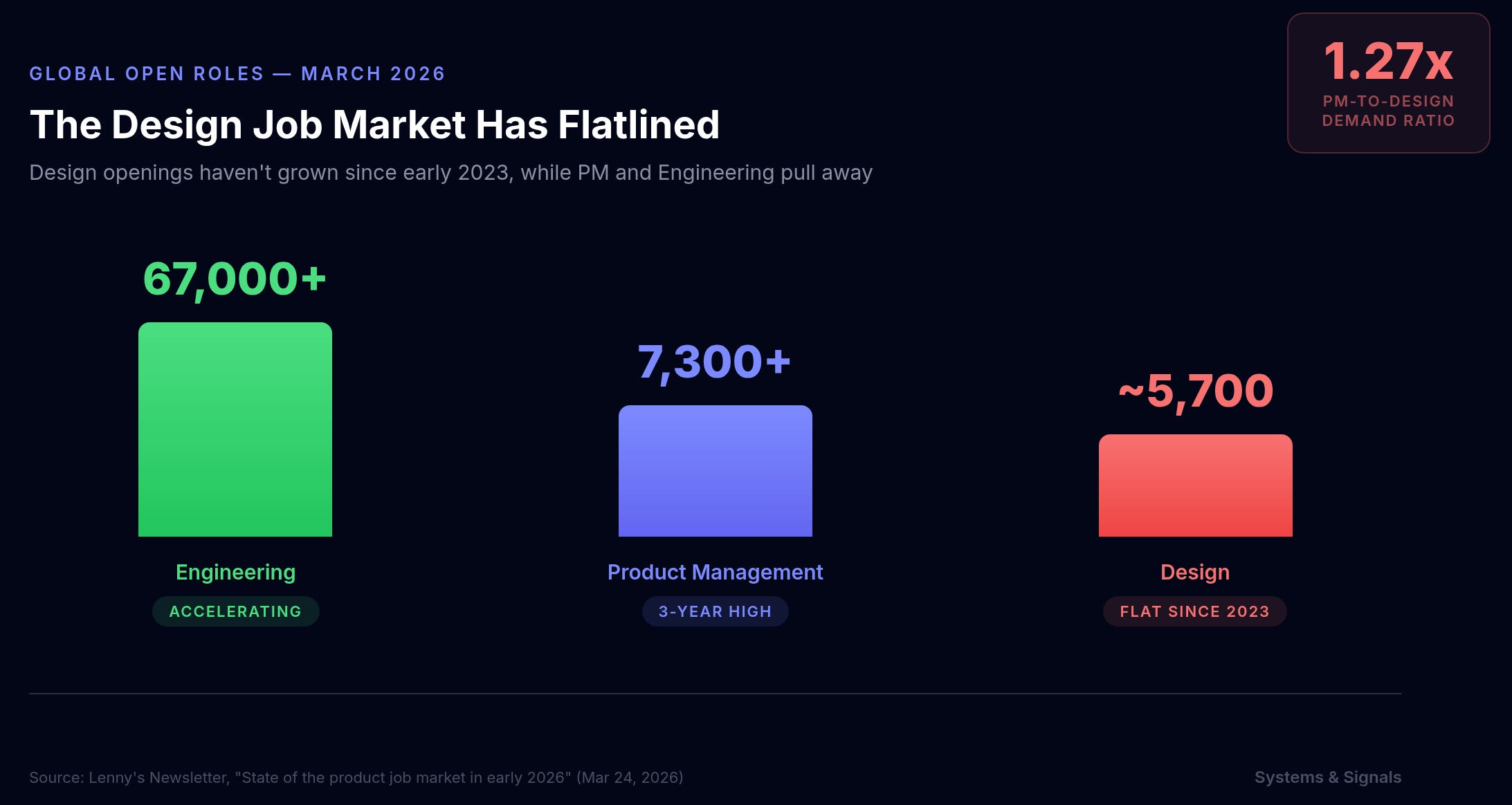
Lenny’s theory on why design hasn’t bounced back the way PM and engineering have: AI is letting engineers move so fast that there’s less opportunity and less desire to involve the traditional design process.
Less desire to involve the traditional design process.
I’ve been turning that sentence over in my head since I read it. Not because it’s wrong, but because it confirms something I’ve been watching play out for a few years now, and that a lot of designers I know have been quietly feeling but not saying out loud.
The ground has shifted and most of us are still walking like it hasn’t.
I spent the first twelve years of my design career following a pretty straightforward formula. Junior designer, mid-level, senior, maybe eventually management. The ladder had rungs. Titles meant something consistent across companies. If you were a “Senior Product Designer,” you had a rough idea of what that entailed.
That predictability is gone, and Lenny’s data is just the macro view. Zoom in and the picture gets messier.
Role Instability. A “Product Designer” at one company could be doing completely different work at another. At one place, you’re deep in research and strategy. At another, you’re executing design specs fed to you by product managers. Same title. Utterly different roles. There’s no standard definition anymore, which means you can’t rely on titles to tell you what you’re actually getting into — or what your value really is.
The Track Blurring. For years, people talked about the “Individual Contributor track vs. management track” like they were two clean paths diverging in a yellow wood. Now they’re tangled. Senior ICs report to junior managers. IC roles demand more people-leadership skills. Management tracks require hands-on craft. Nobody agrees on which one leads where.
Organizational Volatility. Reorgs aren’t rare anymore. They’re the baseline. I’ve watched designers thrive in one structure only to have their entire trajectory upended when the org chart gets redrawn. Three levels disappear. New reporting relationships appear overnight. What you built political capital for yesterday becomes irrelevant today.
Automation of Core Skills. This one connects directly to Lenny’s data. The craft skills that got most of us into this field are being automated. AI can turn a wireframe into a polished mockup in seconds now. Prebuilt component libraries have reduced the “craft every screen from scratch” work that used to be the bulk of the job. Template systems churn out reasonable layouts. When engineers can move that fast without waiting for a designer to hand off specs, the question stops being “how do we make this look good?” and starts being “do we even need someone dedicated to making this look good?”
That’s not a comfortable question. But it’s the one the market is asking.
None of this means design is going away. It means the game is changing, and the rules that kept us safe five years ago won’t protect us anymore.
The old model assumed stability. It assumed that if you gained expertise in your current role, that expertise would stay valuable. It assumed the ladder would still be there next year, with the same rungs in the same places. It assumed that climbing it was the primary goal.
What we’re actually living in is more like a jungle gym. Non-linear. Messy. No clear “top.” And a lot of people are still trying to climb it like it’s a ladder.
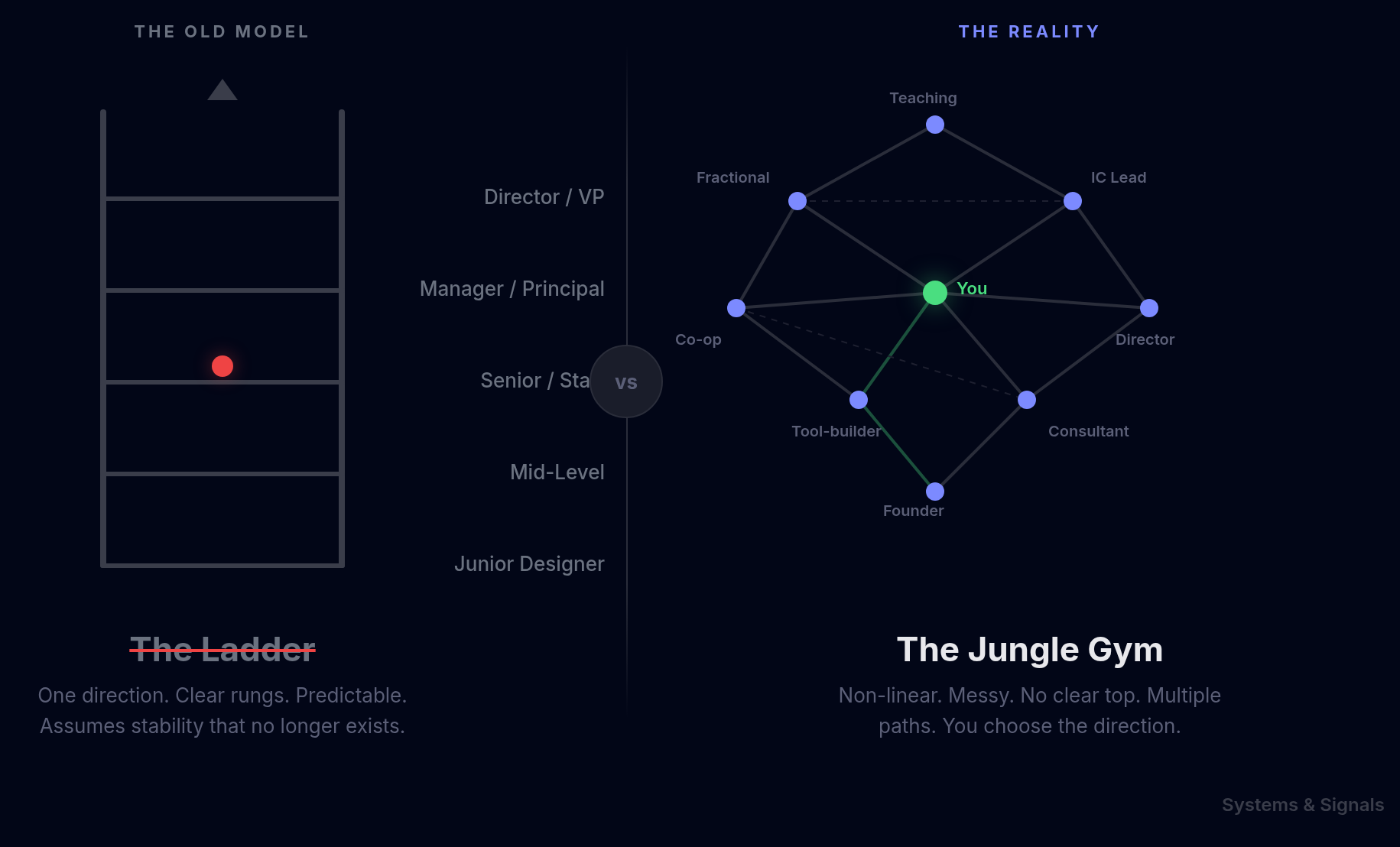
That’s where a Career OS comes in.
Not a five-year plan. Not a motivational framework. Not another system promising you the secret to executive presence or the one weird trick to get promoted. I’m talking about something more fundamental: a living, adaptable system for making intentional decisions about your work, your growth, and your trajectory — knowing that the ground you’re standing on might shift.
A Career OS is how you maintain agency when the organization can’t promise stability. How you stay true to what matters to you when your role description changes every eighteen months. How you build resilience into your career instead of hoping the company will provide it.
Think of it the way you’d design any system: Inputs (what you’re putting in — time, energy, relationships, skills, values), Outputs (what you’re getting back — income, impact, learning, reputation), and Feedback loops (the signals that tell you whether the system is working — recognition, burnout, growth, stagnation).
Most people don’t think about their career this way. They react to what happens. They accept the role they’re offered, adapt to the org chart they’re given, move on when they can’t take it anymore. They treat career growth like it’s something the company does to them instead of something they design.
I’ve done that. A lot of people in my position have. And at a certain point, you realize you’ve been optimizing for inputs and outputs that don’t actually matter — climbing a ladder that’s leaning against the wrong wall.
A Career OS flips that. It starts with clarity about what you actually value, what you actually need, and what you’re actually good at. Then it uses systems thinking to understand how those three things can stay aligned even when everything around you shifts. It gives you levers to pull. It helps you spot patterns before they become crises. It turns your career from something that happens to you into something you’re actively designing.
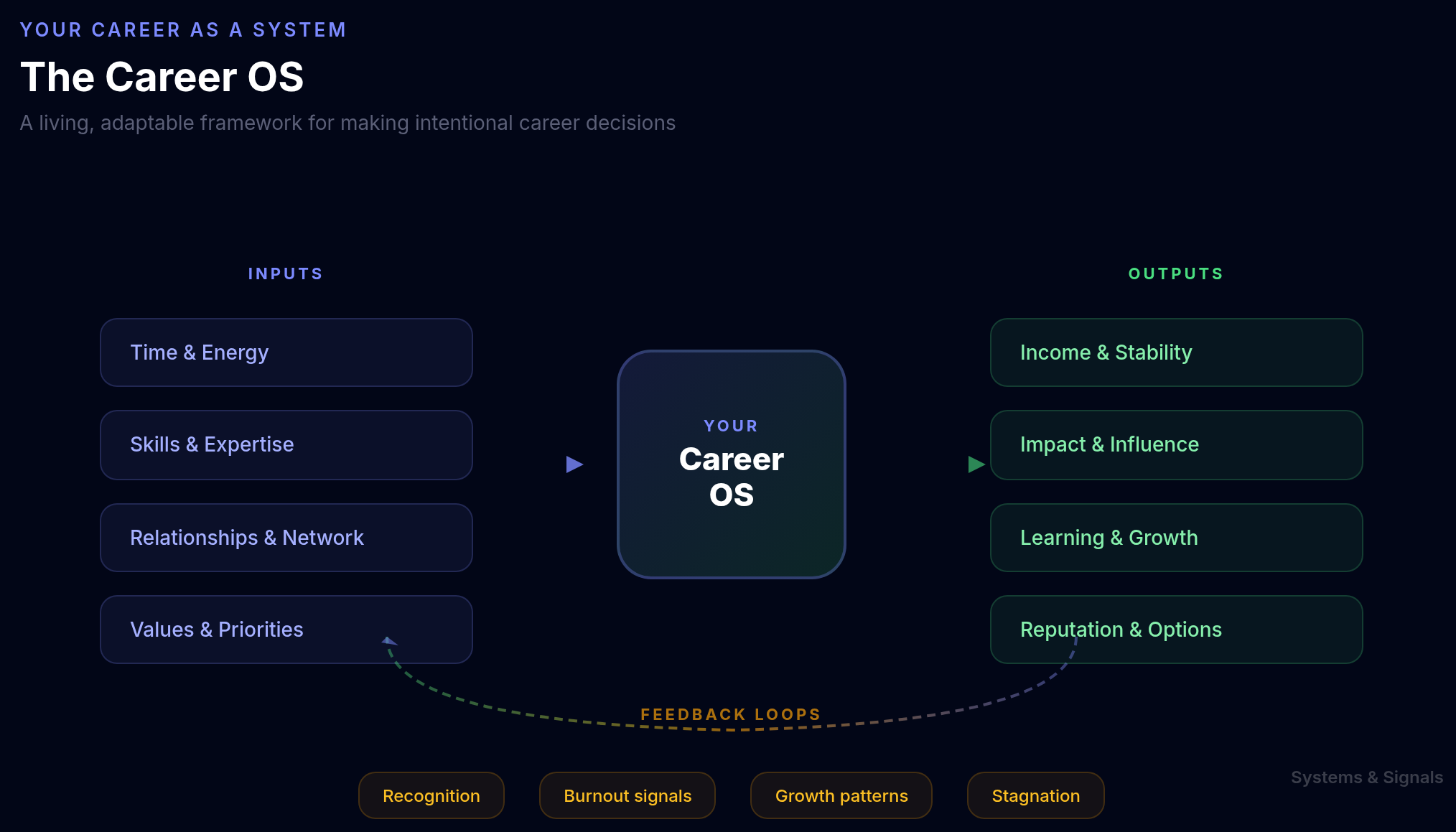
This is the first of a series on building that system. Over the next several weeks, we’ll walk through what it looks like to think like a designer about your own career, why the craftsperson mindset that got most of us here needs to evolve, how to make the invisible parts of your value visible, and concrete ways to build intentionality into the decisions you make every day.
You don’t have to wait for stability to come back. You don’t have to hope the ladder gets reassembled. You can build something more resilient than that.
Activity: Map Your Current System
Take twenty minutes and do this without overthinking it. Draw a simple circle. On the left side, list three inputs you’re regularly feeding into your work — time, energy, specific skills, relationships, values, whatever feels true. On the right, list the outputs you’re actually getting back — income, types of work, learning opportunities, reputation, whatever’s real.
Then the harder part: trace some lines between them. Which inputs are actually driving the outputs you want? Which are just noise? Are there inputs you’re spending energy on that aren’t producing anything meaningful? Are there outputs you want that aren’t connected to any real inputs?
You don’t need to solve it or fix it this week. Just see it. Most people never do.
Subscribe for free or share this post if it resonates.