


The Design Your Next Move Series:
Part 1: Your Design Career Won’t Be Killed by AI; It’ll Be Killed by Inertia
Part 2: Think Like a Designer, Act Like a Strategist
Part 9: Your Career OS Is a Living System
Here’s something I’ve noticed over twenty years of designing products: the best designers aren’t the ones obsessed with pixels — they’re the ones who can zoom out and see the system. They understand that a button doesn’t exist in isolation, that it’s part of a flow, which is part of a feature, which is part of a product, which lives in a market with competitors and economic constraints and user behaviors and organizational incentives. They understand the leverage points, they know which decisions actually move the needle and which are just rearranging deck chairs, and they see patterns repeating and ask why instead of just accepting them.
And yet most of us never apply that same thinking to our own careers.
We design systems for other people all day — we map user journeys, identify friction, trace cause and effect, spot feedback loops. We ask questions like “What’s really driving this behavior?” and “What would happen if we changed that variable?” and “Are we solving the symptom or the problem?” And then we go home and treat our own careers like they’re things that just happen to us.
You wake up one day and realize you’re burned out, so you look for a new job. You get that job, and after six months, you’re burned out again. You tell yourself the company was just broken, and you move to the next one — same story with a different cover. Or you notice you keep getting stuck at a certain level, so you keep grinding: you work harder, stay later, take on more projects, and your skills get better and your portfolio gets stronger, but you still can’t seem to break through. So you assume the problem is you: you’re not good enough, or the company doesn’t value design, or the market is just unfair.
What if the problem isn’t you? What if it’s the system you’re operating in?
Systems thinking changes that equation, because it means looking at your career the way you'd look at any product you're trying to improve:
“A broken system will just use your excellence to make the burnout more efficient.”
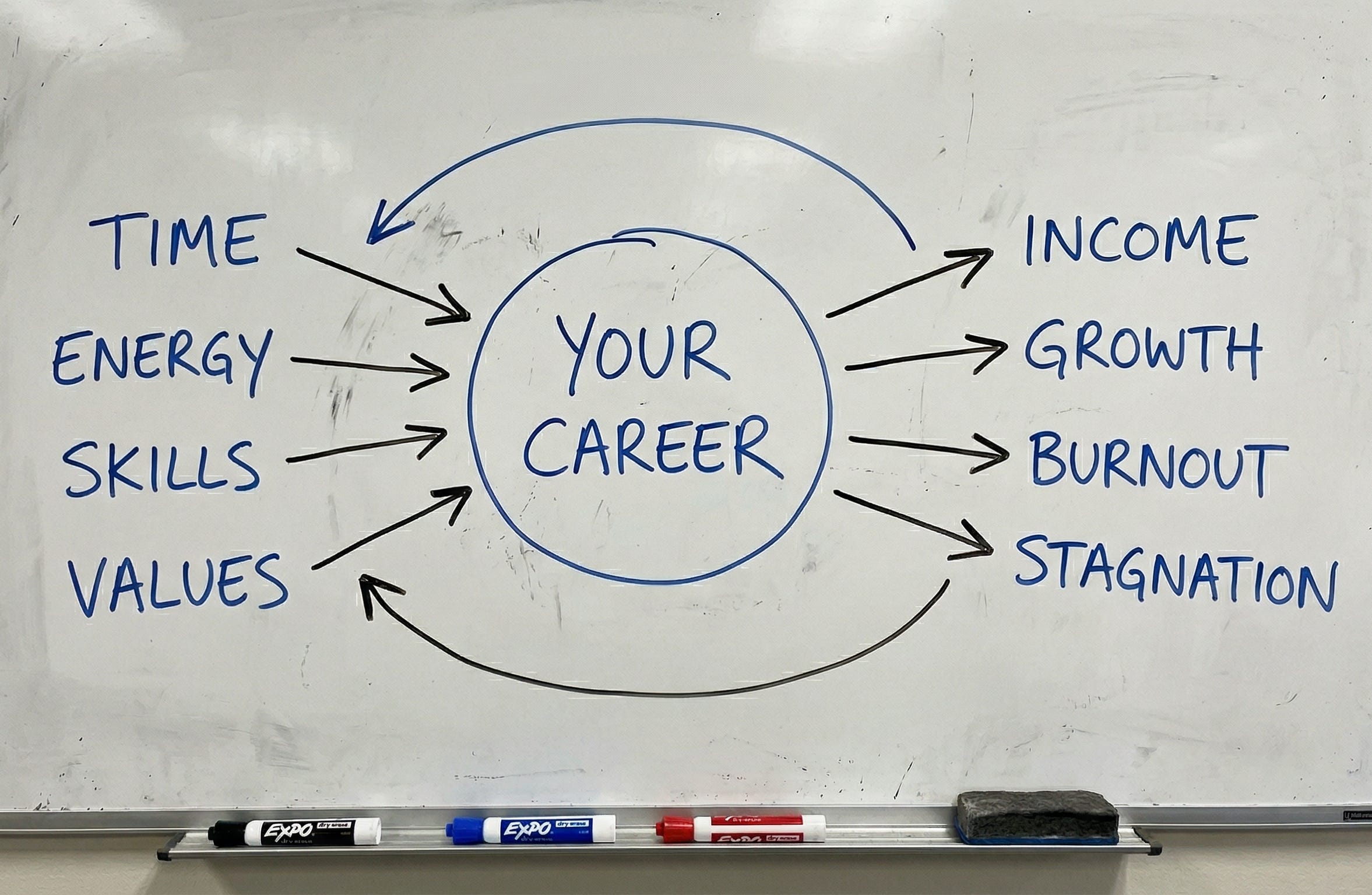
Inputs: What are you actually feeding into this system? Time, obviously, but also energy, relationships, specific skills, your values, your willingness to advocate for yourself, your availability for unpaid emotional labor, how much you’re willing to compromise.
Outputs: What are you actually getting back? Not what you wish you were getting — what you’re actually getting. Income, types of work, learning opportunities, visibility, influence, reputation, burnout, resentment, boredom, growth.
Feedback loops: What are the signals that tell you whether this system is working? Recognition from people who matter to you, exhaustion, interesting problems showing up in your inbox, stagnation, opportunities — or those voices in your head during your commute that are either excited or dreading what’s coming.
Most people never map this stuff out because it feels weird or self-serving to treat your career as a system to optimize, but it’s really just clear-eyed thinking — the same thinking that already makes you a good designer.
Here’s a real example from my own life. A few years back, I realized I was perpetually exhausted — not the good kind of busy, but the kind where you finish a project and can’t celebrate because the next crisis is already heating up. I’d move to a new company thinking a fresh start would help, and within a few months, I’d notice the same pattern emerging.
So I asked myself what was actually in this system.
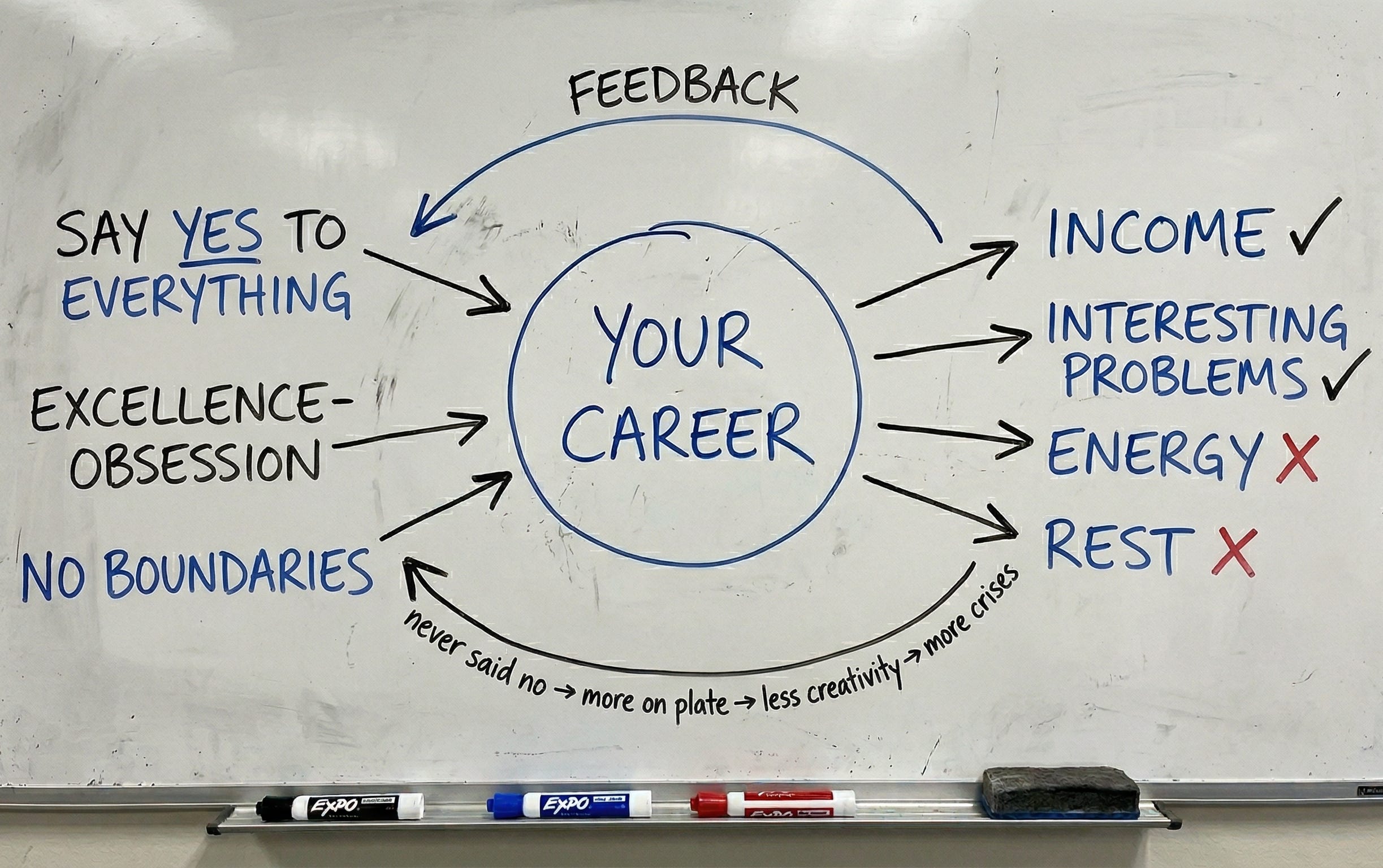
Inputs: I was putting in lots of time, lots of energy, a high degree of excellence-obsession, a willingness to say yes to basically anything, and very little pushback when scope exploded. I was also implicitly trading other things — time with family, sleep, mental space — to fund the work.
Outputs: I was getting income, which was good, and I was getting interesting problems and talented colleagues. But the outputs I wasn’t getting were the ones that actually mattered for sustainability: energy, rest, a sense that the work I was doing was staying done, and any proof that my burnout was actually producing proportional impact.
Feedback loops: The signals were impossible to ignore — I felt exhausted all the time, every project spawned three more projects, people kept adding things to my plate because I’d never said no, and my own creativity was getting crushed under the weight of other people’s urgencies.
I could have blamed the company, or blamed myself for not being resilient enough, or just accepted that this was how design leadership works. Instead, I asked a different question: what levers can I actually pull here?
I couldn’t change the market or the fact that companies are unpredictable, but I could change what I was feeding into the system. I could get more intentional about which projects I said yes to, protect my team from some of the volatility by making different decisions about scope and escalation, change how I communicated my availability, and reduce the one input that was genuinely discretionary: my willingness to absorb crisis on crisis without any boundaries.
That’s what it looks like to think like a designer about your own career.
The craftspeople among us — and most of us are craftspeople — tend to assume that excellence is the answer: work harder, get better, and the system will reward you. And sure, excellence matters, but excellence alone doesn’t fix a broken system. A broken system will just use your excellence to make the burnout more efficient.
Systems thinking means asking different questions: What patterns keep repeating? What invisible forces — organizational politics, cultural expectations, my own assumptions — are shaping my outcomes? Which decisions actually move the needle, and which are just consuming my attention? What feedback loops are reinforcing the outcomes I don’t want, and what would change if I shifted just one variable?
The reason this matters now is that your career no longer comes with a built-in safety net. Companies won’t manage your growth for you, titles won’t mean the same thing in your next role, and the skills that protected you five years ago might not protect you in five more. You can’t rely on the system being stable, so you have to become the person who’s actively designing your system instead of just adapting to it.
And here’s the good news: that’s actually easier than it sounds, because you already do this work. You already know how to spot patterns, identify friction, trace cause and effect, and find leverage points — you’ve just never turned that lens on yourself.
Activity: Audit Your Career System
Same exercise as last week, but deeper. Take that circle you drew with inputs and outputs, and now trace some actual feedback loops.
Pick one output you want more of — learning, influence, impact, whatever — and trace it backward to the inputs that are supposed to generate it. Are those inputs actually happening? How much energy are you really spending on them, and are they connected to the right activities?
Now pick one output you’re getting too much of, whether that’s burnout, busywork, or resentment, and trace it backward. What inputs are feeding that? What decisions are you making that sustain it? Be honest about which of those inputs are actually your choice and which ones you’re telling yourself are fixed.
You’re not trying to solve it this week — you’re trying to see it clearly, and that’s where change actually starts.