


The Design Your Next Move Series:
Part 1: Your Design Career Won’t Be Killed by AI; It’ll Be Killed by Inertia
Part 4: The New Design Skill Stack
Part 9: Your Career OS Is a Living System
Last week I talked about the shift from craftsperson to conductor, which is the idea that your value as a designer is moving from the artifacts you produce to the outcomes you shape. A few people pushed back on that, and I get it. It can sound like I’m saying craft doesn’t matter anymore, which I’m not. Craft still matters. But the definition of craft is changing underneath us, and if you’re not paying attention to what’s replacing the old version, you’re going to wake up one morning wondering why your skillset feels stale.
So let’s get specific. What are the hard skills that are actually shifting? And which soft skills — the ones designers have always been great at — are about to matter more than ever?
The hard skills that are changing
I want to talk about two things that aren’t on most designers’ radar yet but will reshape the work within the next few years: Generative UI and designing for non-deterministic systems.
Generative UI is coming, and it changes everything about how we think about interfaces.
Right now, most of what we design is deterministic — you design a screen, a user taps a button, and something predictable happens. The interface is a fixed thing that you’ve specified in advance, and the engineering team builds exactly what you’ve defined.
Generative UI flips that. Instead of designing every possible screen state, you’re designing systems that generate interface on the fly based on context, user behavior, data, and AI inference. The interface isn’t a fixed artifact anymore — it’s an output of a system that’s making real-time decisions about what to show, how to show it, and when.
Think about what that means for your day-to-day work. You’re not pushing pixels on a screen that ships exactly as you drew it. You’re defining rules, constraints, and guardrails for a system that will compose the interface itself. You’re designing the logic of the experience, not just the layout. You’re thinking about edge cases that don’t have a single right answer because the system might generate something different every time.
That’s a fundamentally different kind of design work. It’s closer to systems design than visual design. It requires you to think in terms of ranges, tolerances, and acceptable outputs rather than fixed specifications. If you’ve ever worked on a design system, you already have some of the mental models — you’ve thought about how components behave in different contexts. Generative UI takes that several levels further.
Non-deterministic systems are the bigger shift, and most designers aren’t ready for it.
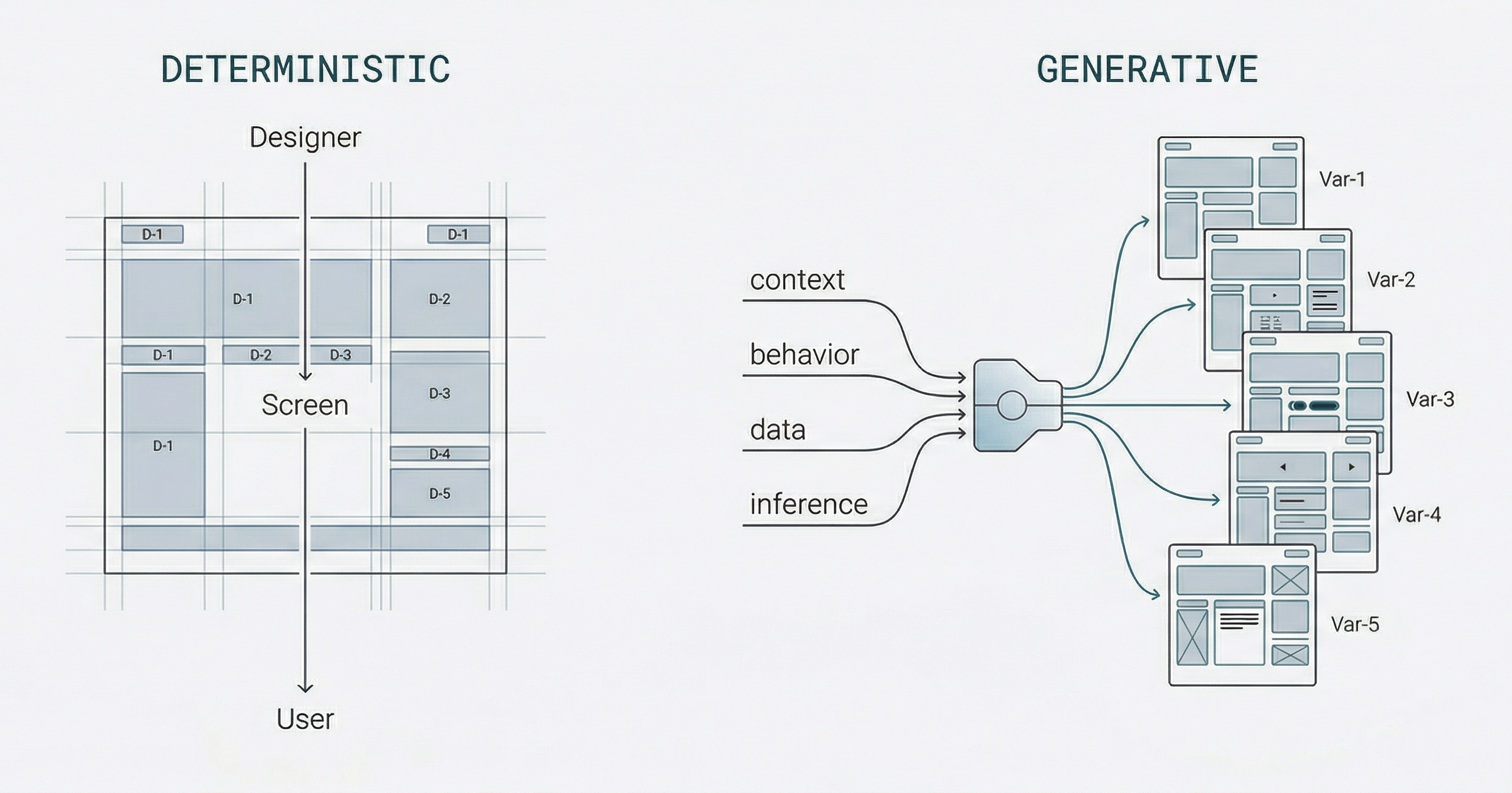
Here’s what I mean. A traditional product is deterministic: the same input produces the same output, every time. You design for that predictability. You can map every user flow because the system behaves consistently.
AI-powered products aren’t like that. The same prompt can produce different responses. The same user action might trigger different system behaviors depending on context the user can’t see. The experience is probabilistic, not fixed. And that breaks most of the frameworks designers have been trained on.
How do you design for trust when the system might give a different answer to the same question? How do you handle error states when the system doesn’t even know it’s wrong? How do you set user expectations when the experience is different every time? How do you create coherence across an interface that’s being partially generated in real time?
These aren’t hypothetical questions. If you’re working on anything that touches LLMs, recommendation engines, personalization systems, or AI-assisted workflows, you’re already designing for non-determinism. You just might not have a vocabulary for it yet.
The designers who figure this out first — who develop intuitions for designing confidence levels, graceful degradation in AI outputs, user controls for probabilistic systems, and feedback mechanisms that help both the user and the model get better — those designers are going to be extraordinarily valuable. Because right now, almost nobody is good at this. The field is wide open.
What else is shifting:
Prompt design is becoming a real skill, not a novelty. Understanding how to craft prompts that produce reliable outputs — and how to design interfaces that help users craft better prompts — is going to be table stakes for product designers within a couple of years. If you’re not experimenting with this now, start.
Data literacy is no longer optional. You don’t need to be a data scientist, but you need to be comfortable reading dashboards, understanding what metrics actually mean, and using data to inform design decisions rather than just gut feel. AI products generate enormous amounts of behavioral data. Designers who can interpret that data and translate it into design decisions will have a significant edge.
Prototyping with code is more valuable than ever. Not because designers need to ship production code, but because the fastest way to test ideas in AI-powered products is often to build a working prototype rather than a static mockup. If you can spin up a quick prototype that actually calls an API, you can test real interactions with real data instead of imagining them.
The soft skills that matter more now, not less
The part that doesn’t get talked about enough is this: as the hard skills shift toward systems thinking and technical fluency, the soft skills that designers have always been quietly great at become more valuable, not less.
Empathy as the real differentiator
AI can generate an interface. It cannot sit with a user and understand the anxiety they feel when a system makes a decision they don’t understand. It cannot read a room full of stakeholders and figure out which unstated concern is actually blocking the project. It cannot build the kind of trust with a product team that comes from years of showing up, listening carefully, and consistently advocating for the people who use the thing.
The more automated the production side of design gets, the more the human judgment side matters. The ability to synthesize messy qualitative data into a clear insight. The ability to hold complexity without rushing to a solution. The ability to say “I think we’re solving the wrong problem” in a room full of people who’ve already committed to a direction.
Storytelling is how you create organizational will
I’ve said this before, but it bears repeating: the designers who move the needle aren’t the ones with the best mockups. They’re the ones who can tell a story that makes a VP of Engineering care about a user experience problem. That skill — translating design thinking into language that resonates with people who don’t think in interfaces — is not automatable. It’s deeply human. And it’s the thing that turns a design recommendation into an actual shipped change.
Facilitation is the invisible superpower
The ability to run a room — to take six people with competing priorities and help them find alignment without anyone feeling steamrolled, to ask the right question at the right time, to create space for the quietest person to say the thing everyone needs to hear. AI is nowhere near being able to do any of that.
If you’re a designer who can facilitate well, you’re already operating in conductor mode whether you realize it or not. That skill becomes more valuable as organizations get more complex, as cross-functional teams become the default, and as the pace of decision-making accelerates.
Cross-functional fluency is your bridge
Designers have always lived between worlds — between engineering and business, between user needs and organizational constraints, between what’s ideal and what’s shippable. That boundary-spanning ability? It’s exactly what’s needed as AI transforms product development. Someone has to translate between what the model can do, what the user needs, what the business wants, and what’s ethically responsible. Designers are naturally positioned to be that translator.
The actual point of all this is that the skill stack isn’t replacing soft skills with hard skills — it’s adding a new layer of technical fluency on top of the human skills that were always the foundation. The designers who thrive in the next five years will be the ones who can speak both languages — who understand Gen UI and non-deterministic systems and who can facilitate a workshop, tell a story, read a room, and build trust.
That’s a higher bar than “make beautiful interfaces.” It’s also a more interesting career.
Activity: Audit Your Skill Stack
Draw two columns. On the left, list the hard skills you use most often in your current role. On the right, list the soft skills you rely on — even the ones that don’t feel like “real” skills.
Now circle anything in the left column that AI can currently do at 70% or better. Be honest. That’s the work that’s going to be commoditized first.
Then look at the right column. Which of those skills do you use constantly but never talk about? Which ones have you been treating as “just part of the job” instead of recognizing them as core to your value?
Finally, look at the gaps. Where are Gen UI, non-deterministic design, prompt design, or data literacy in your stack? You don’t need to be an expert tomorrow. But if they’re nowhere on your radar, that’s a signal worth paying attention to.